

blog
Smith Machine vs Functional Trainer: What’s the Difference and Which One Fits Your Home Gym?
September 15, 2026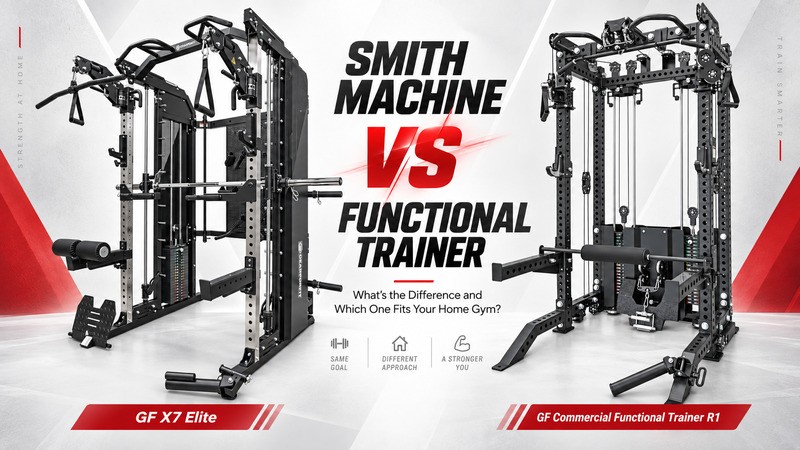 When you're building a home gym, two pieces of equipment often end up near the top of the shopping list: a Smith machine and a functional trainer.
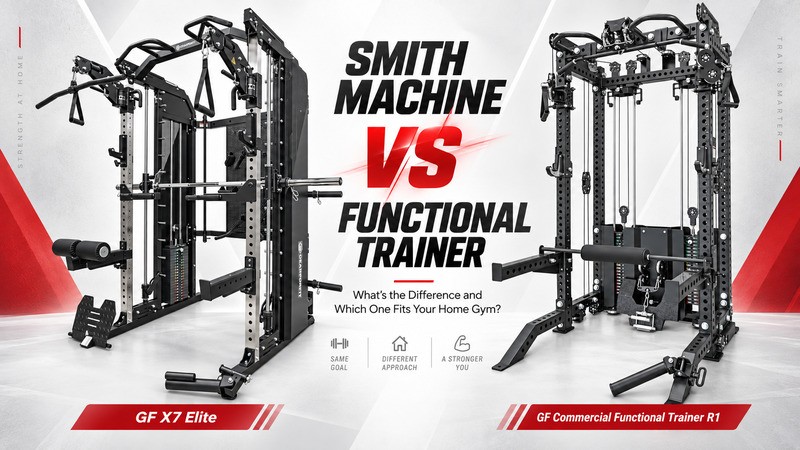
Both can become the centrepiece of a home gym, but they are designed for very different types of training. A Smith machine gives you a guided barbell for squats, presses and other loaded movements, while a functional trainer uses adjustable cables to create resistance from multiple angles.
So which one should you choose?
The answer depends on how you train, how much space you have and whether you want to focus primarily on heavy compound lifts, cable exercises, or a combination of both.
What Is a Smith Machine?
A Smith machine uses a barbell that moves along fixed vertical or near-vertical guide rails. Unlike a traditional free-weight barbell, the bar remains connected to the machine throughout the movement.
Most Smith machines also include multiple locking positions, allowing you to rotate or re-rack the bar at different heights during an exercise.
Common Smith machine exercises include:
- Squats
- Front squats
- Bench press
- Incline bench press
- Shoulder press
- Romanian deadlifts
- Split squats
- Lunges
- Calf raises
- Hip thrusts
- Rows
Because the bar follows a guided path, many people find a Smith machine convenient when training alone or performing exercises where they want more stability.
What Is a Functional Trainer?
A functional trainer is a cable-based strength machine, typically equipped with two independently adjustable pulleys.
The pulleys can usually be moved to different heights, allowing resistance to come from above, below, or approximately any point in between.
Instead of loading a barbell, most functional trainers use selectorized weight stacks. You choose the resistance by moving a weight pin, attach the appropriate handle or bar, and begin your exercise.
Popular functional trainer exercises include:
- Cable chest flyes
- Cable presses
- Lat pulldowns
- Seated and standing rows
- Face pulls
- Triceps pushdowns
- Biceps curls
- Lateral raises
- Rear-delt flyes
- Cable kickbacks
- Pull-throughs
- Wood chops and rotational exercises
- Single-arm and single-leg exercises
The biggest advantage of a functional trainer is versatility. Because the cable can pull from many different angles, one machine can be used for an extremely wide range of upper-body, lower-body and core exercises.
Smith Machine vs Functional Trainer: The Main Difference
The simplest way to understand the difference is this:
A Smith machine is primarily a guided barbell system, while a functional trainer is primarily an adjustable cable system.
| Feature | Smith Machine | Functional Trainer |
|---|---|---|
| Resistance Type | Guided barbell | Adjustable cables |
| Best For | Squats, presses and heavier compound movements | Cable exercises, isolation work and functional movements |
| Movement Path | Fixed | Highly adjustable |
| Exercise Variety | Moderate to high | Very high |
| Easy Resistance Changes | Usually requires loading or removing plates | Usually adjusted with a weight-stack pin |
| Training Alone | Convenient due to multiple bar locking positions | Very convenient for cable exercises |
| Unilateral Training | Limited | Excellent |
Which Is Better for Building Muscle?
Both machines can be effective for muscle-building workouts, but they accomplish the goal differently.
A Smith machine is particularly useful for exercises where you want to load a movement heavily while maintaining a predictable bar path.
For example, Smith machine squats, presses, lunges and Romanian deadlifts can all be used as major movements in a hypertrophy-focused workout.
A functional trainer is particularly useful for creating additional exercise variations and targeting muscles from different angles.
Cable flyes, lateral raises, curls, pushdowns and rows are easy to set up, and the cable continues to provide resistance throughout the movement.
For a bodybuilding-style home gym, having access to both systems can provide significantly more exercise variety than either machine alone.
Which Is Better for Heavy Strength Training?
If your workouts centre around heavier squats, presses and similar compound exercises, a Smith machine will generally play the larger role.
The guided bar allows you to progressively add resistance to traditional barbell-style movements without having to control the bar in every direction.
However, a Smith machine should not automatically be confused with a power rack.
A power rack is designed for exercises using a traditional free barbell, while the Smith bar stays attached to its guide system.
Many modern all-in-one home gym systems include both a Smith machine and power rack, giving you the option to train with either a guided bar or a traditional Olympic barbell.
Which Is Better for Exercise Variety?
For pure exercise variety, the functional trainer usually has the advantage.
Moving an adjustable pulley by just a few positions can completely change the angle of an exercise. Different handles and attachments expand the number of possibilities even further.
For example, one cable column can be used for:
- Low cable curls
- Mid-height chest presses
- High cable face pulls
- Triceps extensions
- Single-arm rows
- Leg kickbacks
- Core rotations
This makes a functional trainer especially useful for people who enjoy bodybuilding, general fitness, sports-specific exercises, accessory work or full-body cable workouts.
Which Is Better if You Train Alone?
Both can work very well for solo home-gym training.
A Smith machine has multiple locking positions along the rails, which means the bar can be re-racked during the movement without another person having to take the bar from you.
A functional trainer is also naturally suited to solo workouts because the resistance remains controlled by the cable system and weight stack.
For someone who regularly trains alone at home, having access to both systems can be particularly convenient.
Which Is Better for Beginners?
Beginners can benefit from either machine.
A Smith machine provides a predictable bar path, which can make certain exercises easier to set up while the user becomes comfortable with resistance training.
A functional trainer makes it simple to start with lighter resistance and gradually increase the load. Most exercises can also be adjusted quickly by moving the pulley or changing the weight-stack pin.
The more important factor for a beginner is choosing exercises appropriate for their ability and learning correct technique rather than selecting one particular type of machine.
Which Takes Up More Space?
This depends heavily on the specific machine.
Compact functional trainers can take up relatively little floor space, particularly wall-mounted models. Larger dual-column functional trainers require more width but can still replace several individual cable stations.
Smith machines are generally built around a larger frame and require additional clearance for the Smith bar, weight plates, bench and the user.
Before buying either type of machine, measure:
- Ceiling height
- Available room width
- Available room depth
- Door and staircase clearance
- Bench clearance
- Space needed to load weight plates
- Space required to perform cable exercises
Remember that the listed dimensions of the machine are not the same as the amount of usable workout space you will need around it.
What About a Smith Machine With a Functional Trainer?
This is where modern home gym equipment becomes particularly interesting.
You do not necessarily have to choose between a Smith machine and a functional trainer.
Many all-in-one trainers combine several training stations into one frame, including:
- Smith machine
- Dual adjustable functional trainer
- Power rack
- Pull-up station
- Lat pulldown
- Low row
- J-hooks
- Safety arms
- Weight storage
- Multiple cable attachments
For a home gym where floor space is limited, this type of system can provide a large amount of training functionality without requiring three or four separate machines.
You can explore GearForFit's All-in-One Smith Machines to compare systems that combine multiple strength-training stations into a single footprint.
Smith Machine vs Functional Trainer: Which Should You Buy?
If you are choosing only one machine, start by looking at the exercises you perform most often.
Choose a Smith Machine If:
- Your workouts focus heavily on squats, presses and loaded compound movements.
- You like barbell-style exercises but want a guided bar path.
- You frequently train alone.
- You want to progressively load lower-body and pressing exercises.
- You plan to build your gym around traditional strength training.
Choose a Functional Trainer If:
- You want the widest possible range of cable exercises.
- You enjoy bodybuilding and accessory exercises.
- You want to train muscles from multiple angles.
- You perform a lot of unilateral exercises.
- You want quick resistance changes between exercises.
- You want one cable machine that can train almost every major muscle group.
Browse GearForFit's Functional Trainers to compare compact cable trainers, power-rack combinations and full-size functional training systems.
Consider an All-in-One Trainer If:
- You want both a Smith machine and functional trainer.
- You also want a power rack for free-weight exercises.
- Your home gym has limited floor space.
- You want one main machine to handle most of your strength workouts.
- Several people with different training styles will use the gym.
Smith Machine vs Functional Trainer: Quick Comparison
| Your Priority | Better Fit |
|---|---|
| Heavy squats and presses | Smith Machine |
| Cable exercise variety | Functional Trainer |
| Isolation exercises | Functional Trainer |
| Guided barbell exercises | Smith Machine |
| Unilateral training | Functional Trainer |
| Maximum versatility from one machine | Smith Machine + Functional Trainer Combo |
| Small home gym with multiple training goals | All-in-One Trainer |
Can a Functional Trainer Replace a Smith Machine?
Not completely.
A functional trainer can reproduce an enormous number of movements, but cables do not provide the same training experience as loading a guided Smith bar for squats, presses or similar exercises.
Likewise, a Smith machine cannot reproduce all of the movement angles and independent cable exercises available on a functional trainer.
The two systems overlap in some areas, but they are better viewed as complementary pieces of equipment rather than direct replacements for each other.
Can a Smith Machine Replace a Functional Trainer?
Again, not completely.
A Smith machine is excellent for guided barbell movements but cannot provide the same freedom of direction as adjustable cables.
Exercises such as cable crossovers, face pulls, cable lateral raises, rotational core exercises and many single-arm movements are much easier to perform on a functional trainer.
Which Is Best for a Home Gym?
There is no single answer for every home gym.
If your priority is loaded squats, presses and other traditional strength exercises, a Smith machine may be the more useful starting point.
If you value exercise variety, cable work and the ability to train from many different angles, a functional trainer may make more sense.
But if you know you will eventually want both, an all-in-one system can often make better use of your available floor space than purchasing each station separately.
GearForFit carries All-in-One Smith Machines and Functional Trainers for home gyms ranging from compact basement setups to large dedicated training rooms.
Before ordering, compare the dimensions, weight system, pulley configuration, included attachments and available workout space to determine which setup works best for your gym.
If you prefer to compare equipment in person, you can also visit the GearForFit showroom in Markham, Ontario and test different training systems before making your decision.