

blog
Belt Squat: How to Load Your Legs Heavy and Spare Your Spine
November 01, 2026
Every lifter knows the trade-off of the barbell squat: it builds legs like nothing else, but the bar sits directly on your spine, and your lower back often fails before your legs do. The belt squat removes that trade-off entirely. The load hangs from your hips instead of resting on your back — so your legs become the only limiting factor.
What a belt squat actually is
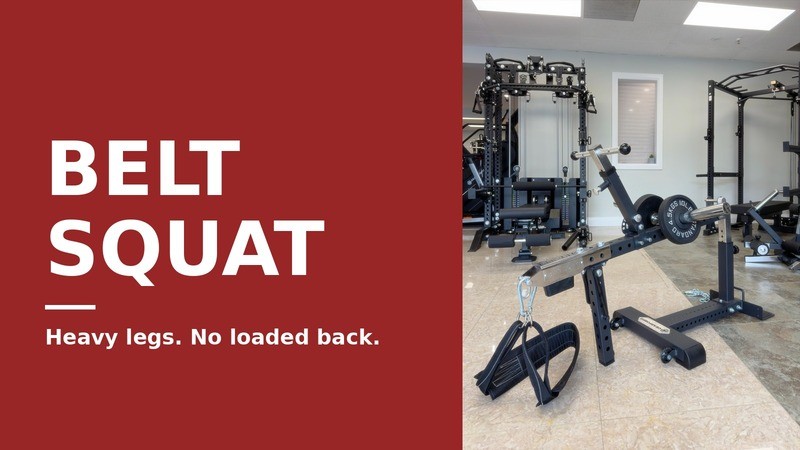
In a belt squat, you wear a wide belt around your pelvis. A chain connects the belt to a weighted lever arm (on a machine) or to plates hanging between your feet (in a DIY setup). When you squat, the weight pulls straight down from your hips. There is no bar on your shoulders, nothing compressing your spine, and nothing to unrack or re-rack — you clip in at the bottom, stand up, and squat.
The movement pattern is still a squat: hips and knees bend together, torso stays tall. What's different is where the force enters your body — through the pelvis, about as close to your centre of mass as resistance can get.
Belt Squat Benefits: Why Lifters Swear By It
No axial loading. "Axial load" is the force travelling down your spine from a bar on your back. Remove the bar, and that compression disappears — while the legs still work against the same weight.
Legs fail, not your back. In a heavy back squat, the set often ends because the lower back fatigues or form breaks down, not because the quads are spent. Studies comparing the two movements find similar muscle activation in the quads, glutes and hamstrings during belt squats, with significantly less demand on the trunk and spinal erectors. In plain terms: your legs get the same workout, your back doesn't pay for it.
A naturally upright torso. Because the load hangs below you, there's no forward lean to fight. That upright position shifts emphasis toward the quads and makes the belt squat a friendly way to learn — or re-learn — a clean squat pattern.
Safe to push to failure. No pins, no spotter, no bar to dump. When your legs are done, you simply sit down and unclip. That makes the belt squat unusually good for honest high-rep work.
A bit of history
The belt squat earned its reputation in powerlifting gyms. At Westside Barbell, Louie Simmons used belt squat variations heavily — including for lifters training around back injuries who couldn't put a bar on their backs but still needed to load their legs hard. What started as a workaround for injured powerlifters turned out to be a tool healthy lifters wanted too, and the machines slowly spread from hardcore gyms into commercial and home setups.
Who gets the most out of it
- Lifters with a cranky lower back who still want to train legs heavy (as always with injuries: clear it with your physio).
- Anyone with shoulder or neck limitations — there's no bar to get under, so upper-body mobility is irrelevant.
- Beginners building a squat pattern without a barbell intimidating them.
- Athletes in-season, who need leg strength without the spinal fatigue that heavy squats leave behind.
- Home gym owners adding a second leg day: belt squats deliver volume your back won't complain about tomorrow.
Technique: getting it right
- Belt low on the pelvis, sitting on the hip bones — not up around your waist. Too high, and it pulls on your lower back; too low, and it slips mid-set.
- Clip in at the bottom. Squat down, attach the chain, then stand to tension.
- Feet in your natural stance, on the platform so the chain hangs close to vertical beneath you.
- Brace your trunk anyway. "Spine-friendly" doesn't mean "floppy" — a braced core keeps the pelvis stable.
- Full, controlled reps. Drive through the whole foot, stand tall, and don't bounce out of the bottom.
If a handle is provided, it's a balance aid — rest your fingers on it. Hauling on it with your arms quietly turns a leg exercise into a partial row.
Variations that change the target
- Stance width: a wider stance brings in more glute and adductor; narrow brings the quads forward.
- Heels elevated (small plates or wedges under the heels): more knee travel, more quads.
- Tempo reps: a 3-second descent with a pause at the bottom removes momentum and makes moderate weight feel serious.
- Marching belt squats: stepping in place at the bottom position under load — a Westside favourite for hip strength and athletic carryover.
- Constant-tension sets: don't lock out fully between reps; brutal as a finisher in the 15–25 rep range.
Where it fits in your training
- As the main lift on a lighter-back week or a second leg day: 3–4 sets of 8–12.
- As a finisher after barbell work: 2–3 sets of 15–25 with constant tension.
- As a squat replacement while a back or shoulder issue heals: keep the same slot in the session you'd give the barbell.
What it won't do: replace the barbell squat's trunk-strength and bracing demands if you compete in powerlifting. Think of the two as partners — the barbell builds the whole system, the belt squat lets the legs outwork everything else.
Setups: from DIY to dedicated machines
The budget version is a dip belt, plates, and two boxes to stand on so the plates can hang between your feet — it works, but it's fiddly to set up and the swinging plates take practice. Cable-based setups are smoother. Dedicated machines use a lever arm and are the most stable option; newer freestanding designs (GearForFit carries one example) store vertically and roll out of the way, which solved the old problem of belt squat machines eating half a garage.
The takeaway
The belt squat isn't a gimmick or an easier squat — it's the same leg training with the bill sent to a different address. If your back has ever ended a leg day before your legs did, you'll understand the appeal in a single set.
FAQ
What is a belt squat?
- A squat where the load hangs from a wide belt around your pelvis instead of a bar on your shoulders, so your legs work without compressing your spine.
Is a belt squat as effective as a back squat for legs?
- Studies comparing the two find similar activation in the quads, glutes and hamstrings during belt squats, with significantly less demand on the trunk and spinal erectors.
Can I belt squat with a bad back?
- Many lifters with a cranky lower back use it to train legs heavy — but as always with injuries, clear it with your physio first.
What do I need for a belt squat at home?
- A dip belt, plates and two boxes to stand on will work. A dedicated freestanding machine is the most stable option, and it stores vertically.