

blog
Kettlebells by the Numbers: What the Science Actually Says
November 15, 2026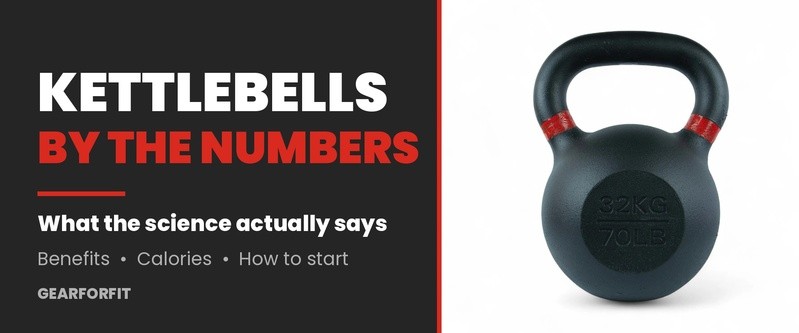
Can one piece of equipment build strength, challenge your cardiovascular system and fit into a 20-minute workout? Kettlebells make a convincing case. But some of the numbers circulating online—especially the claim that kettlebells burn 400 calories in 20 minutes—need context.
Here's what the research actually tells us about kettlebell benefits, calorie burn, strength and conditioning, plus a straightforward workout for anyone getting started.
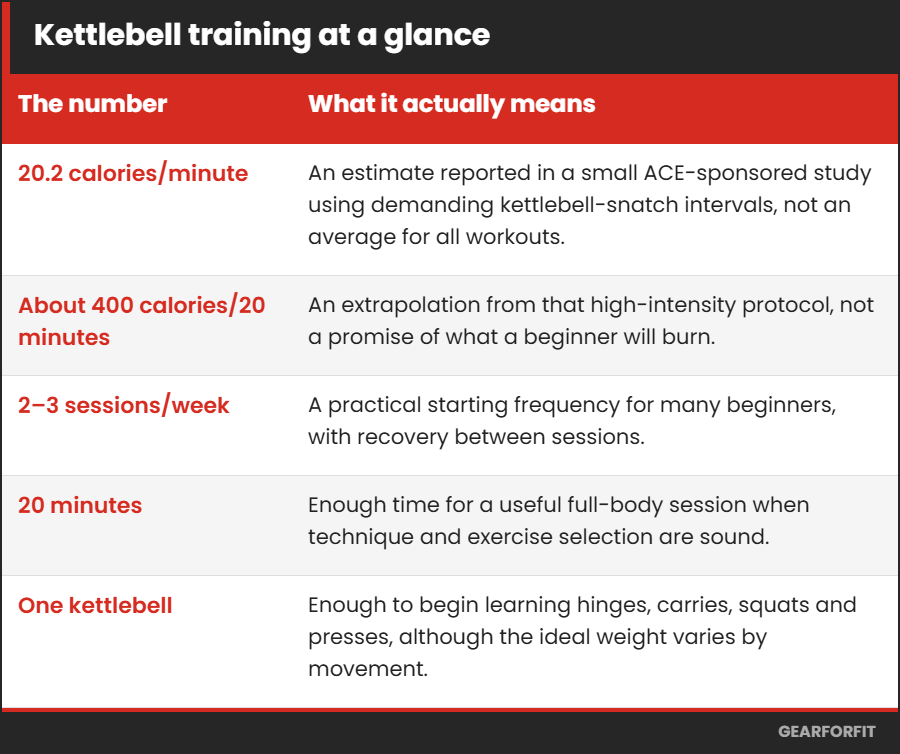
Kettlebell training at a glance
1. How many calories does kettlebell training burn?
The best-known number comes from research commissioned by the American Council on Exercise (ACE) and conducted at the University of Wisconsin–La Crosse. Researchers measured participants performing repeated kettlebell snatches in a demanding interval workout. The widely cited estimate was 20.2 calories per minute, combining aerobic and anaerobic energy expenditure.
That works out to approximately 404 calories over 20 minutes—but there's a catch. This was a small study involving people who could perform the snatch protocol, not a general test of everyday kettlebell exercise. Anaerobic calorie estimates also depend on measurement assumptions. You shouldn't expect the same result from a relaxed 20-minute session of swings, squats and rest periods.
What affects your actual calorie burn? Your body size, training experience, exercise selection, load, work-to-rest ratio and intensity all matter. A heart-rate watch may provide an estimate, but it isn't a precise calorie meter—particularly during resistance training.
Bottom line: Kettlebells can deliver vigorous conditioning, but the headline calorie figure is a high-intensity research result, not a universal guarantee.
2. Five kettlebell benefits worth knowing
Full-body strength with minimal equipment
A kettlebell swing primarily trains a powerful hip hinge, involving the glutes, hamstrings and trunk while requiring grip and upper-body control. Goblet squats, rows, carries and presses expand the stimulus across the body. The exact muscles and adaptations depend on which exercises you perform.
Cardiovascular conditioning
Repeated swings, cleans or snatches can elevate heart rate substantially. Studies of kettlebell protocols have reported meaningful cardiovascular demands, although a high heart rate alone doesn't prove that an exercise is equivalent to running or cycling at the same heart rate.
Power and athletic movement
Ballistic exercises such as swings emphasize forceful hip extension. Research including work by Lake and Lauder suggests kettlebell training can improve aspects of strength and explosive performance. The results depend on the program, and traditional heavy lifting remains valuable for maximizing absolute strength.
Grip and trunk control
Carries, rows and swings require you to hold and stabilize an offset load. They can be useful components of a broader program for grip endurance and trunk strength, provided you progress gradually.
A compact home-gym setup
One bell takes little floor space and supports several movement patterns. That makes kettlebells especially practical when you want a strength-and-conditioning option without a full rack of equipment. For more on their background and appeal, read From Cannonballs to Flow: Why Kettlebells Deserve a Spot in Your Training.
3. Can kettlebells actually build muscle?
Yes—but exercise selection and progressive overload matter more than the shape of the weight. Squats, presses, rows and other sufficiently challenging kettlebell movements can support muscle growth, particularly for beginners. To keep progressing, gradually increase load, repetitions, sets or difficulty while maintaining good technique.
A six-week comparison by Otto and colleagues examined kettlebell and traditional weightlifting training and found improvements in performance measures. It does not establish that kettlebells are superior for hypertrophy, nor does it mean every kettlebell program produces the same results.
For maximizing muscle size, heavier resistance and a wider range of incremental loads may be easier to manage with dumbbells, barbells or machines. Kettlebells are a useful tool—not a replacement for every other one.
4. Kettlebells vs. dumbbells: which should you use?
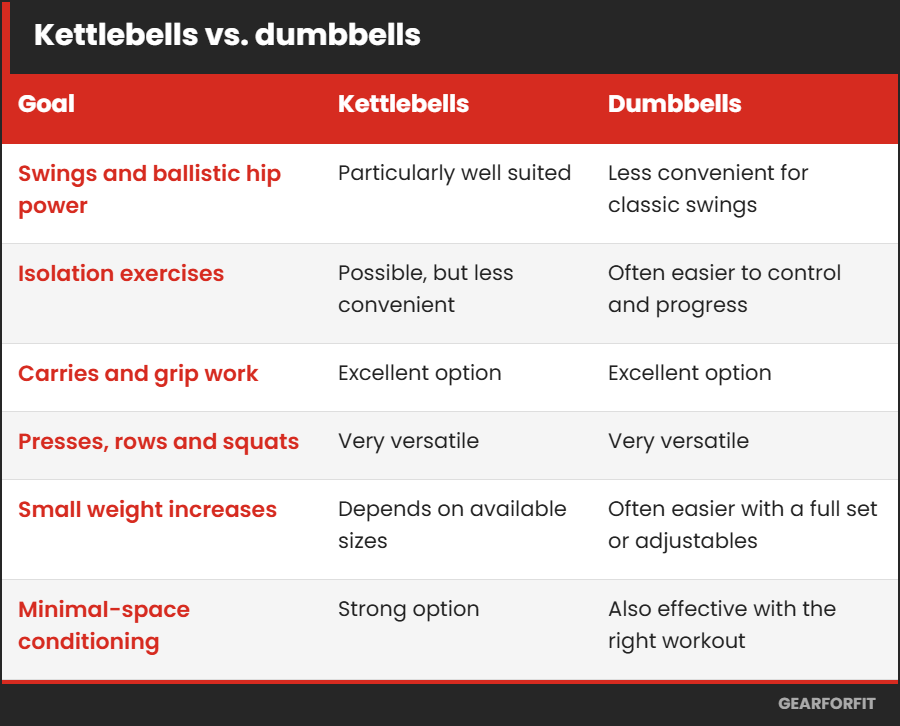
Neither tool automatically burns more calories. The workout—not simply the equipment—determines the training demand. For a closer comparison, see Dumbbells vs. Kettlebells: Which to Choose?.
5. What kettlebell weight should a beginner choose?
You may see 8 kg for women and 16 kg for men recommended as starting points. Those are rough conventions, not rules. Strength, prior lifting experience, mobility and the exercise itself are better guides than gender.
A sensible first kettlebell should let you perform a controlled deadlift and goblet squat without losing posture. The load you can swing safely may be too heavy to press overhead, so one bell won't necessarily be ideal for every movement.
Practical selection guide:
- New to resistance training: Try a light-to-moderate bell under supervision or in a store; prioritize comfortable, controlled deadlifts and goblet squats.
- Already strength training: Test a moderate bell that challenges your hips and legs without pulling you out of position.
- Planning overhead presses: Check that you can control the bell throughout the full range before choosing a weight for pressing.
If possible, test more than one weight. Choose smooth handle edges, a stable flat base and a grip size that fits your hand. A traditional cast-iron bell can be a durable, straightforward option. For an example of this style, see the GearForFit 20 kg (44 lb) cast-iron kettlebell. That 20 kg bell is not a default beginner recommendation.
6. A 20-minute beginner kettlebell workout
This session emphasizes basic movement patterns before advanced ballistic exercises. If you've never learned a hip hinge, practice it unloaded first and consider coaching before attempting swings.
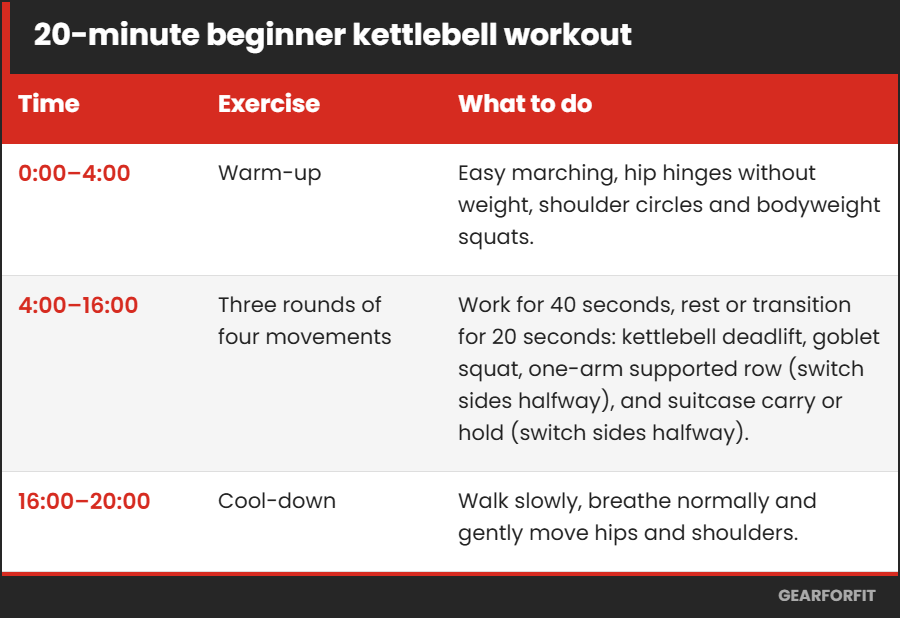
Make it easier: Work for 25–30 seconds and use the rest of each minute to recover. Stop a set if your technique deteriorates. For the carry, walk only if you have a clear path; otherwise use a stationary suitcase hold.
When to add swings: Once you can hinge with a neutral, controlled back and drive the movement through your hips rather than lifting with your arms, learn the two-handed swing with appropriate instruction. Avoid making high-repetition snatches your first kettlebell workout.
7. How often should you train with kettlebells?
For most beginners, two or three nonconsecutive sessions per week is a practical place to start. Build up gradually rather than chasing exhaustion every workout. A training program that includes strength work, aerobic activity and recovery will generally be more balanced than kettlebell training alone.
Some kettlebell intervention studies have reported improvements in aerobic fitness over several weeks, but results vary with participants, exercise protocols and how fitness was measured. Treat any single percentage improvement as a study-specific result, not a prediction of your own progress.
8. Common kettlebell mistakes to avoid
- Starting too heavy. A weight that forces you to round your back, twist or compensate is not a useful challenge.
- Squatting the swing. A classic swing is primarily a hip hinge, not a front raise or deep squat.
- Lifting the bell with your shoulders. In a swing, the hips generate the movement; the arms guide the bell.
- Skipping recovery. More intensity is not always better, especially while learning technique.
- Comparing calorie numbers. A study's maximum-effort estimate isn't a fair benchmark for an ordinary workout.
If you experience chest pain, fainting, unusual breathlessness or significant dizziness, stop exercising and seek appropriate medical evaluation. Anyone with an injury or cardiovascular condition should adapt training with a qualified clinician or coach.
Frequently asked questions about kettlebell training
How many calories do kettlebell workouts burn?
Calorie burn varies with body size, exercise selection and intensity. A small ACE-sponsored study reported approximately 20.2 calories per minute during demanding kettlebell-snatch intervals, but that is not a reliable estimate for a typical beginner workout. Avoid treating 400 calories in 20 minutes as a guaranteed outcome.
Are kettlebells better than dumbbells?
Neither is universally better. Kettlebells are particularly convenient for swings, ballistic exercises and compact conditioning workouts. Dumbbells are often more convenient for isolation exercises and small weight increases. Both can build strength when used progressively.
What weight kettlebell should a beginner start with?
Choose a weight based on strength, experience and the movement—not gender alone. Common starting suggestions range from about 8 to 16 kg, but some beginners need lighter weights and others can handle more. Test a controlled deadlift and goblet squat before deciding, and use a lighter bell for overhead work if necessary.
Can you build muscle with kettlebells?
Yes. Challenging kettlebell squats, presses and rows can support muscle growth when you progressively increase training demands. For maximum hypertrophy, combining kettlebells with other resistance equipment may make progressive loading easier.
How often should you train with kettlebells?
Two or three sessions per week, with recovery days between harder sessions, is a practical beginner schedule. Start with manageable workouts of around 20–30 minutes and increase volume or intensity as your technique and recovery improve.
The takeaway: use the numbers, but understand the context
Kettlebells offer a lot in a small package: strength training, conditioning, coordination and a flexible way to exercise at home. Research supports their usefulness, but it doesn't support every viral calorie claim or the idea that one piece of equipment is automatically best for every goal.
Start with a weight you can control, learn the hinge, train consistently and measure progress by better technique and strength—not just calories on a screen.
Research and further reading
- American Council on Exercise (ACE). Kettlebells: Twice the Results in Half the Time? ACE-sponsored research conducted at the University of Wisconsin–La Crosse (2010). Original source for the widely quoted 20.2-calorie-per-minute estimate.
- Lake, J. P., & Lauder, M. A. Kettlebell swing training improves maximal and explosive strength. Journal of Strength and Conditioning Research (2012).
- Otto, W. H., III, et al. Effects of weightlifting vs. kettlebell training on vertical jump, strength, and body composition. Journal of Strength and Conditioning Research (2012).