

blog
.jpg)
The Evolution of Strength Equipment: From Iron to Intelligent Design
February 15, 2026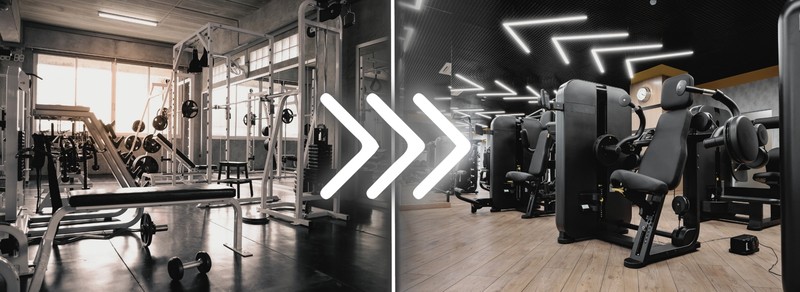
Strength training has never been more popular. Commercial facilities are expanding, home gyms are becoming more sophisticated, and buyers are no longer satisfied with basic steel frames and heavy stacks. But something important has shifted in 2026. The conversation is no longer about how much weight a machine can hold. It is about how intelligently that weight is delivered.
Modern strength equipment is evolving beyond raw capacity. Today, serious buyers evaluate stability, resistance smoothness, footprint efficiency, ergonomics, and long-term durability. The industry has matured. And so have its customers.
Stability Is the New Standard
There was a time when marketing revolved around maximum load ratings. A machine boasting a 1,000-pound capacity seemed impressive on paper. But experienced lifters know that true performance is not defined by numbers alone. It is defined by how the machine behaves under load.
Structural rigidity has become the new benchmark. Frames built with 3×3 steel, 11-gauge construction, reinforced pivot points, and wide base geometry create a foundation that eliminates flex and instability. When equipment does not shift or rock, the body can focus entirely on muscular tension rather than compensation. This improves activation, enhances joint safety, and increases user confidence under heavy resistance.
The Resurgence of Plate-Loaded Precision
Plate-loaded machines are experiencing a strong resurgence, particularly in strength-focused environments. Their appeal lies in mechanical simplicity combined with performance authenticity. Plate-loaded systems provide a direct load feel that closely resembles free-weight training, while still offering guided stability.
However, modern plate-loaded machines are far more refined than their early counterparts. Adjustable lever arms, independent movement paths, converging press patterns, and linear bearings have transformed them into biomechanically sophisticated tools. They now bridge the gap between free weights and selectorized machines, offering both control and intensity.
Another advantage is long-term ownership cost. Without complex internal stacks or extensive cable systems, maintenance demands are often lower. For facilities prioritizing durability and progressive overload flexibility, plate-loaded systems remain highly attractive.
Selectorized Equipment Has Evolved
While plate-loaded equipment is rising, selectorized machines have not disappeared. Instead, they have improved significantly. Modern weight-stack systems now incorporate smoother guide rods, optimized cam profiles, improved pulley efficiency, and clearly marked adjustment points.
These refinements matter in commercial environments where member flow and accessibility are critical. Quick adjustments reduce wait times and increase usability for beginners and advanced athletes alike. The best facilities today strategically blend plate-loaded equipment for heavy compound strength with selectorized machines for isolation, safety, and accessibility.
Space Efficiency and Integrated Systems
One of the most significant shifts in equipment design is the move toward integration. Instead of dedicating space to separate racks, cable systems, and specialty stations, modern multi-function units combine these capabilities into cohesive platforms.
Integrated systems may include rack uprights, dual pulley columns, plate storage, landmine attachments, and lat pulldown or low row functions within a single footprint. For home gyms and boutique studios, maximizing movement coverage per square foot is no longer optional — it is essential. Smart layouts now prioritize versatility over excess.
Ergonomics and Biomechanics Take Priority
Poorly designed machines often lead to shoulder irritation, knee strain, or lower back compensation. Users may avoid certain equipment simply because it feels unnatural. Modern engineering addresses this problem directly.
Natural joint alignment, adjustable seat depth, converging press paths, and neutral grip options are no longer premium features — they are expected standards. The most effective machines feel intuitive from the first repetition. When alignment supports movement instead of fighting it, training quality improves dramatically.
Durability as a Long-Term Investment
Aesthetic appeal alone is no longer enough. Buyers increasingly evaluate construction quality beneath the surface. Steel grade, weld consistency, bearing type, cable rating, and powder-coating durability all influence long-term return on investment.
A machine that performs reliably for ten years ultimately costs less than replacing lower-grade equipment multiple times. In serious facilities, durability is not an expense — it is a strategic financial decision.
The Rise of Intentional Equipment Selection
Perhaps the most important shift in 2026 is not technological, but psychological. Buyers are becoming more intentional. Instead of attempting to fill a room with every possible machine, they are asking smarter questions.
Which movement patterns must be covered? Who is the primary user base? What equipment will see daily use? What supports progressive overload? Strategic selection now defines professional environments, while cluttered setups quickly reveal a lack of planning.
Strength Equipment Evolution Comparison
| Category | Earlier Focus | Modern Focus (2026) | Impact |
|---|---|---|---|
| Frame Construction | Maximum weight rating | Structural rigidity and anti-flex design | Greater stability and safety |
| Resistance Delivery | Basic load application | Biomechanically refined resistance curves | Improved muscle targeting |
| Plate-Loaded Systems | Simple lever mechanics | Independent and converging movement paths | More natural strength development |
| Selectorized Machines | Fixed cam systems | Optimized pulleys and smoother guide rods | Consistent tension and usability |
| Footprint Strategy | Single-use machines | Integrated multi-function platforms | Higher ROI per square foot |
| Durability Standards | Visual appearance | Reinforced pivots and commercial-grade components | Long-term performance reliability |
| Buying Approach | Quantity-driven | Strategic and movement-focused | Smarter capital allocation |
Strength equipment is no longer just steel and cables assembled into a frame. It represents engineering, biomechanics, spatial efficiency, financial planning, and user psychology. The future of strength training does not lie in accumulating more machines. It lies in selecting the right ones with precision and purpose.
When equipment is chosen intentionally, it does more than occupy space. It builds stronger bodies, supports safer movement patterns, and delivers performance that lasts for years.